Most businesses spend years building a reputation — through referrals, track records, and careful positioning. Then a prospective client lands on their website and sees something that looks like it was built in 2014 with a free template. That disconnect does real damage.
A website is rarely neutral. It either reinforces the quality of your business or quietly undermines it. For industries where credibility and trust are the entire product — luxury brands, property, professional services — the visual and technical standard of your site carries significant commercial weight.
First Impressions Happen in Milliseconds
Research consistently shows that people form a visual judgement about a website within a fraction of a second. Before they have read a single word of copy, absorbed your proposition, or looked at your portfolio, they have already made a subconscious call on whether this business looks like the real thing.
For a premium brand, a slow-loading page, inconsistent typography, or a layout that falls apart on mobile is not a minor inconvenience. It is a signal — and not the one you want to send.
What Clean, Premium Design Actually Communicates
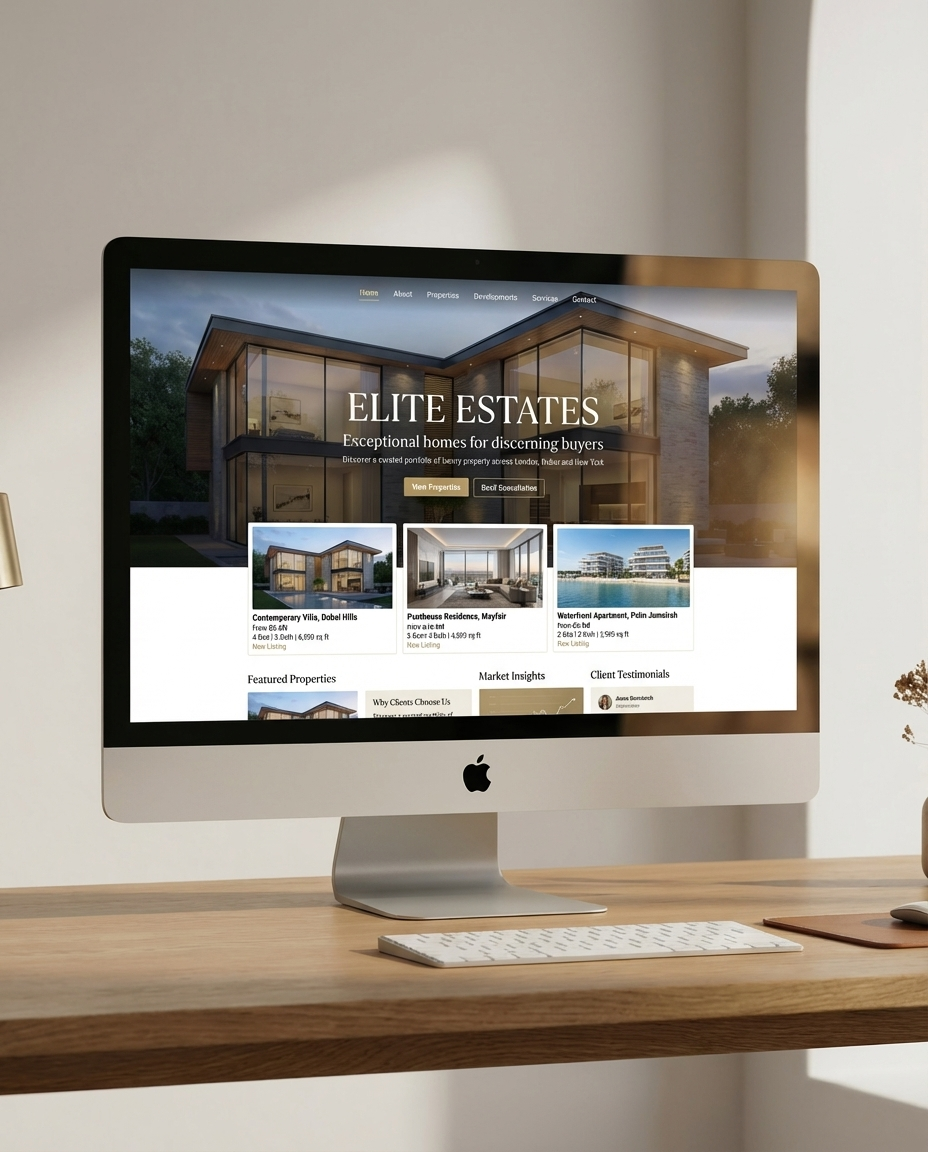
There is a meaningful difference between a website that looks expensive and one that simply has a large image behind a headline. Premium design is about restraint, hierarchy, and confidence. It does not shout. It does not clutter. It gives information room to breathe and guides the visitor's attention without forcing it.
For property businesses, this might mean full-bleed imagery, minimal navigation, and a layout that frames listings as desirable rather than merely available. For professional services, it often means tight typography, clear service structure, and a tone that communicates competence before a single case study is read. The design does not replace your message — it makes your message land properly.
A Dated Website Is an Active Business Problem
We hear a fairly predictable version of this from clients who have been putting off a rebuild: the website has been "good enough" for years, most work comes through referrals anyway, and a redesign always ends up at the bottom of the priority list.
The problem is that referrals still check the website. An introducer might speak warmly of your business, but the first thing their contact does is Google you. If what they find does not match the recommendation, you have introduced doubt into what should have been a warm conversion. That lost confidence rarely announces itself — the lead simply goes quiet.
Slow load times compound this. A site that takes more than three seconds to load on mobile will shed a significant portion of its visitors before a single page is seen. If your site is running on an old platform with unoptimised images and no performance consideration, that is not a technical footnote — it is costing you enquiries.
Design and Conversion Are the Same Conversation
A common mistake is treating visual design and conversion as separate concerns — one handled by creatives, the other by marketers. In practice, the two are inseparable. The decisions that make a site look authoritative are often the same decisions that guide a visitor toward an enquiry.
Clear hierarchy tells people where to look. Confident, well-placed calls to action reduce friction at the point of decision. A contact process that feels considered rather than bolted-on signals that the business itself is considered. None of this is accidental in a well-built site — it is designed in from the beginning.
This is why we approach web projects as a single brief covering brand expression, user experience, and commercial performance together. Separating them produces sites that either look good but convert poorly, or convert aggressively but feel cheap.
The Businesses That Benefit Most
While almost every business benefits from a stronger website, the return on investment is sharpest where trust and first impressions directly influence whether an enquiry is made at all. Luxury retail, residential and commercial property, legal and financial services, architecture and interiors — these are sectors where the quality of the website is taken as a proxy for the quality of the service.
If your business operates in one of these areas and your current site does not reflect the standard of your actual work, the gap between perception and reality is working against you every day.
We have been building websites since 2001 — across sectors, platforms, and more than a few complete shifts in how the web works. If you are considering a redesign or wondering whether your current site is doing the job it should, take a look at our recent work or get in touch to talk it through.