Most agency calls end the same way: a screen full of notes, a shared action list, and a week of follow-up emails to confirm who is doing what by when. We got tired of that process a long time ago, so we built something different.
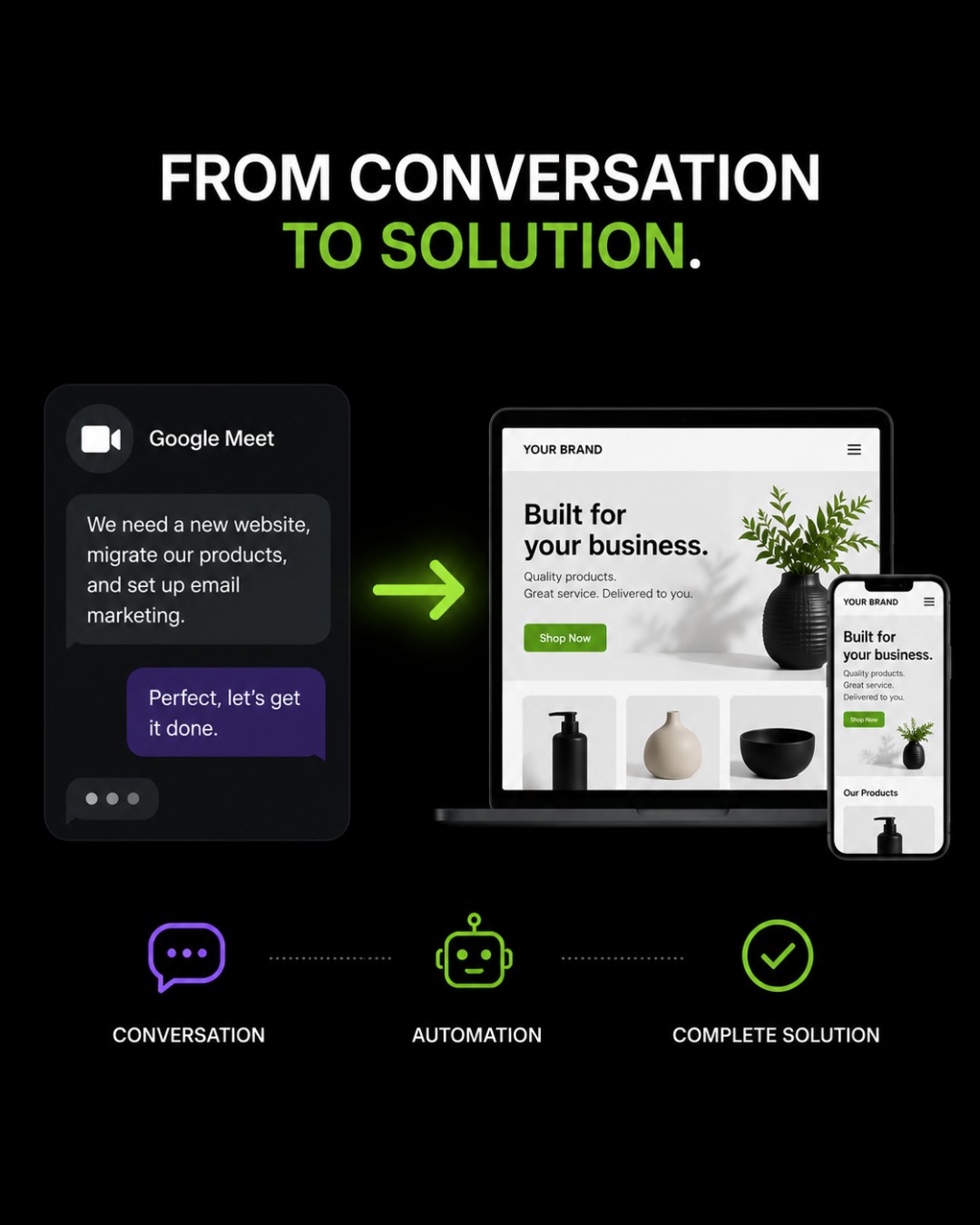
Last week, a client joined us on a Google Meet call. Fifteen minutes later, the work was done. Not scheduled. Not scoped. Done.
That is not a metaphor or a marketing line. It is a description of how our systems now operate, and it is worth explaining what actually happened.
What Happened in Those 15 Minutes
The call was automatically transcribed as it ran. Our systems analysed the transcript, identified every action item, and began executing them without anyone opening a task manager or writing a single note.
From that one conversation, we updated the client's website, migrated products and content from their existing Shopify store, configured a brand-new email marketing platform, and produced the first campaigns ready to send. We also generated a structured implementation plan for anything that needed client sign-off before going live.
No follow-up email asking "can you confirm what you wanted on the homepage". No Monday morning catch-up to check progress. The conversation became the brief, and the brief became the output.
Why We Invested in Building This
Agencies are historically good at being busy. Lots of meetings, lots of documentation, lots of process around the work rather than the work itself. Clients pay for results, not for the machinery that produces them.
We have spent considerable time and resource building automated workflows that connect the tools we already use: transcription, task extraction, CMS updates, e-commerce platforms, and email systems. The goal was not to reduce headcount. It was to remove the layer of repetitive administration that sits between a client conversation and a delivered outcome.
When that layer goes away, the people doing the work can focus on the parts that actually require judgement: strategy, creative decisions, problem-solving, and the kind of thinking that cannot be automated.
The Difference Between Automation and Genuine Integration
There is a version of "automation" that means a few Zapier triggers and an auto-reply email. That is not what we are describing here.
What we have built is a connected system where a spoken conversation at 9am can result in a live website change, a populated product catalogue, and a drafted email campaign before lunch. The transcription layer understands context, not just keywords. The action extraction is specific enough to know the difference between "we should probably update the about page" and "update the about page to include the new team photo".
That specificity matters. Vague automation creates more work to clean up. Precise automation creates time.
What This Means for Clients Working With Us
For clients, the practical effect is straightforward: less time in calls, less time waiting, and a clearer record of what was agreed and what was done.
The implementation plan our systems produce for anything requiring approval also means clients are never left guessing. They receive a structured document showing exactly what is ready to go live and what needs a decision from their side. That removes the ambiguity that drags projects out.
We are not suggesting every piece of work can be completed in a quarter-hour call. Complex projects still need careful planning and iteration. But the administrative overhead that used to add days to straightforward tasks has largely disappeared from how we operate.
The Broader Point About How Agencies Should Work
If a call ends and the next action is writing up what was discussed, something has gone wrong with the process. The bottleneck in most agency relationships is not capability or intention; it is the gap between a decision being made and that decision being acted upon.
Closing that gap is not about replacing the people who do good work. It is about making sure they spend their time on the work that is genuinely hard, rather than on the administrative translation layer that sits around it.
We built these systems for ourselves first, because we held ourselves to the same standard we ask clients to apply to their own businesses: if a process is slow and repetitive, it should either be fixed or removed.
If your agency relationships still involve a notebook full of actions at the end of every call, it might be worth having a conversation about what working differently could look like. You can see more about how we work and what we have delivered for clients before deciding whether it is worth your time.